Gabriel’s flock
Three Bags FullGabriel’s flock is a group of short-fleeced meat sheep that Gabriel brings to Glennkill meadow and confines behind wire. Their arrival changes the pasture’s balance: they occupy ground the resident flock used, then advance toward George’s Place in a dense, difficult-to-stop mass. Their purpose as meat animals emerges through the frightened testimony of one of their own rams. The flock is therefore both a physical force in the pasture and a warning of what livestock production can hide beneath the ordinary acts of feeding and shepherding.
Arrival and Organization
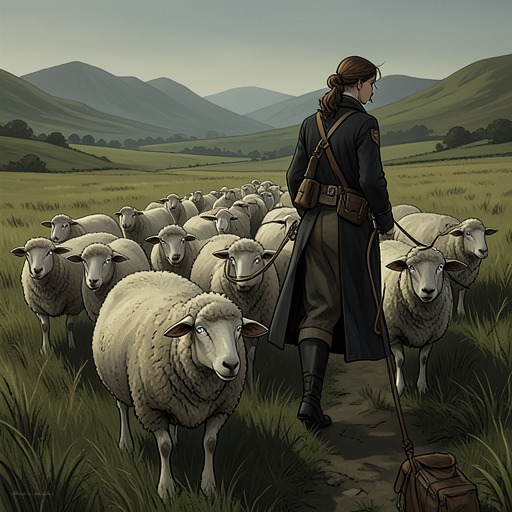
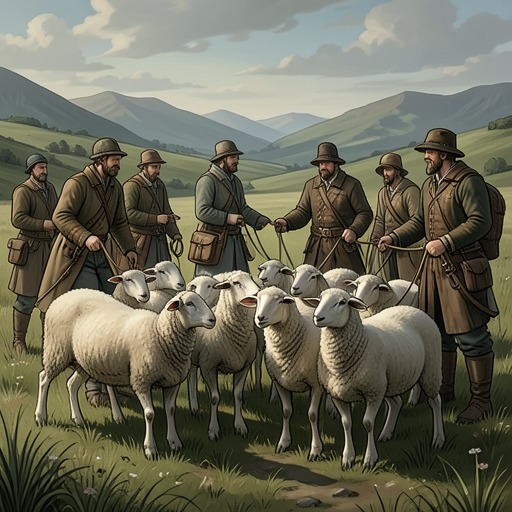
The flock first appears as an approaching movement of animals, Dogs, and human voices. The sound reaches the sheep before the newcomers do; the resident flock hears a humming rush and barking, then sees a flock unlike any it has known moving toward the meadow. Gabriel gathers his animals at one side of the pasture and puts up a wire fence around them. The enclosure reduces the space available to the resident flock, a loss felt not only in the general contraction of the meadow but in the removal of ground where mouse weed grows.
Gabriel’s flock is kept apart rather than allowed to mingle freely. Its members graze within their fenced patch while Gabriel tends to the barrier and their movements. When Gabriel returns early one morning without his crook or Dogs, but carrying a ladder, the flock has already grazed half its allotted patch bare. He glances at them and then goes to the crows’ tree, leaving the newcomers’ presence as an established feature of the meadow. The pen makes the flock’s management visible: their grazing space is assigned and bounded, and their presence alters the resident sheep’s access to pasture.
Appearance and First Impressions
The resident sheep initially read the newcomers through their bodies and scent. Gabriel’s flock has short legs, long backs, long noses, restless eyes, and unusually pale coloring. Its members have almost no fleece, only a dense curly down against the skin, though they do not appear to have been shorn. To sheep accustomed to wool, that difference raises a practical question: what use can there be in sheep that do not grow a proper fleece?
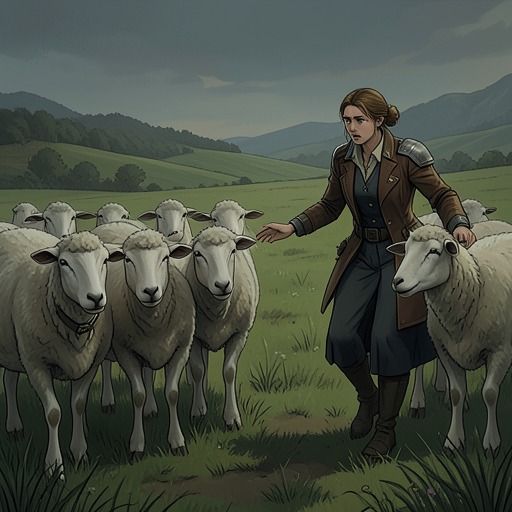
The newcomers also seem nervous and lifeless to their observers, and their scent is described as unpleasant without seeming unhealthy. Their close grouping reinforces the impression of unease. When Zora approaches, she sees them grazing shoulder to shoulder, so tightly packed that the arrangement looks uncomfortable. They do not acknowledge her at first; their eyes pass over her as though she were invisible. Only after she bleats loudly do their muzzles stop and their necks rise, turning countless pale eyes toward her. The encounter shows how their collective stillness and close formation make them difficult for an outsider to read.
Miss Maple’s later discrimination between different groups sharpens the distinction. Gabriel’s flock has an easily recognized, flat scent and seems to consist of young ewes and rams, one or two years old, with little difference between them. The flock that Maple senses in a strange, incomplete vision is not Gabriel’s: it carries the varied scent of old rams, mothers, lambs, experience, and youthful energy. The contrast prevents the pale newcomers from being mistaken for that other, more varied presence and underlines how strongly Maple relies on scent to distinguish one flock from another.
Grazing Conflict
At first the resident sheep are curious about Gabriel’s animals but also relieved that they will not be running freely through the same space. Some find them too strange to approach, and the group’s pride competes with its wish to understand them. Zora eventually crosses the distance because she believes curiosity should not be stopped by pride. Her attempt to make contact meets silence and wary attention rather than welcome.
The separation does not hold. At night, Gabriel’s flock breaks out of its fenced patch and moves toward the hay barn in a compact phalanx of necks and feeding heads. In the darkness the animals look paler still, almost luminous, and their sheer number becomes apparent. They advance close together, as difficult to halt as a machine moving across a field. Zora calls Gabriel a bad shepherd for failing to keep his fence secure, but the immediate danger is not simply poor fencing: the escaped flock is grazing toward ground the resident sheep are trying to protect.
Othello proposes that the defenders stand together where they are, reasoning that Gabriel’s flock cannot graze George’s Place if it cannot get past them. The plan sounds simple until the pale wave reaches the line. Some of the newcomers raise their heads to scent the resident sheep, then trot forward, bleating about fodder. They press into the defenders as they would force a way through a hedge, their behavior revealing how little the resident flock’s attempted boundary means to them. Their drive to feed and the other flock’s need to hold its ground turn grazing into a direct contest over space.
The Meaning of Meat
Gabriel’s use of George’s scythe gives the pasture a more disturbing appearance. He retrieves the tool from the shed behind the caravan and cuts grass at the foot of the hill. The sheep have seen George polish the blade, but have not understood its purpose. In Gabriel’s hands it passes through the grass with a hostile sound, leaving flattened blades behind. He appears to graze without wanting the grass himself; the cutting looks to the sheep like destruction rather than feeding. Their distress comes partly from the sight of a human taking part in the work of pasture in a way that makes no sense to them.
Zora’s conversation with one of Gabriel’s rams supplies the explanation. When she asks whether Gabriel is death, the ram rejects the idea that a shepherd could be death and tells her that the flock is meat. He explains the sequence in stark terms: they eat, grow fat, and die. Grass, in his understanding, leads toward that end. Zora recognizes the significance of the label meat breed and understands that the flock is being fed for slaughter. The ram’s lowered head and silence after describing his own fate give the knowledge a personal weight: he is not offering an abstract account of husbandry but warning Zora about what awaits him and his companions. He urges her to run away.
Pastoral and Narrative Significance
Gabriel’s flock unsettles the resident sheep’s image of a pasture as a place of abundant, ordinary grazing. The meadow is bounded by fences, divided between groups, and subject to a shepherd’s decisions about where animals may feed. Gabriel’s scythe makes the provision of grass look like violence, while the ram’s account reveals that abundant feeding can serve a purpose opposite to continued life. The flock’s pale bodies and sparse coats are thus not simply visual curiosities: they prompt questions about what kind of sheep they are and what humans intend to do with them.
The group also gives the story a concrete contrast between two ways of being a flock. Gabriel’s animals are penned close together, described by the resident sheep as uniform and difficult to approach, and driven toward food in a collective press. Yet one ram can interpret their condition and communicate its consequence to Zora. His warning breaks through the resident flock’s initial assumption that the newcomers are merely odd neighbors. Gabriel’s flock becomes a community whose quiet, apparently routine grazing conceals an imminent fate—and whose single act of testimony transforms that fate into something the other sheep can recognize.